
Pinterest earnings for the third quarter arrived with a record that sounds like pure good news: 661 million people used the service in September, 10% more than a year earlier. The money tells a narrower story. According to the company’s results release filed with the SEC, the US and Canada supplied about three of every four revenue dollars, even though they hold only about one in six users.
Revenue rose 12% to $1.174 billion for the quarter ended September 30. That was short of the roughly $1.21 billion analysts expected, and the shares fell sharply after the October 29 report, Investing.com reported. Most coverage stopped at the miss. Instead, we took the regional table at the bottom of the release and asked a simpler question: where did the new users come from, and where did the new money come from?
Sixteen percent of users, 76 percent of the money
The Pinterest earnings release splits the business into three regions. The US and Canada had 107 million monthly active users and $894 million in revenue. Europe had 161 million users and $193 million. Everywhere else, which Pinterest calls Rest of World, had 394 million users but only $87 million.
Put as shares, the gap is stark. North America is 16% of the audience and 76% of revenue. Europe is 24% of users and 16% of revenue. Meanwhile, Rest of World is 60% of users and just 7% of revenue.
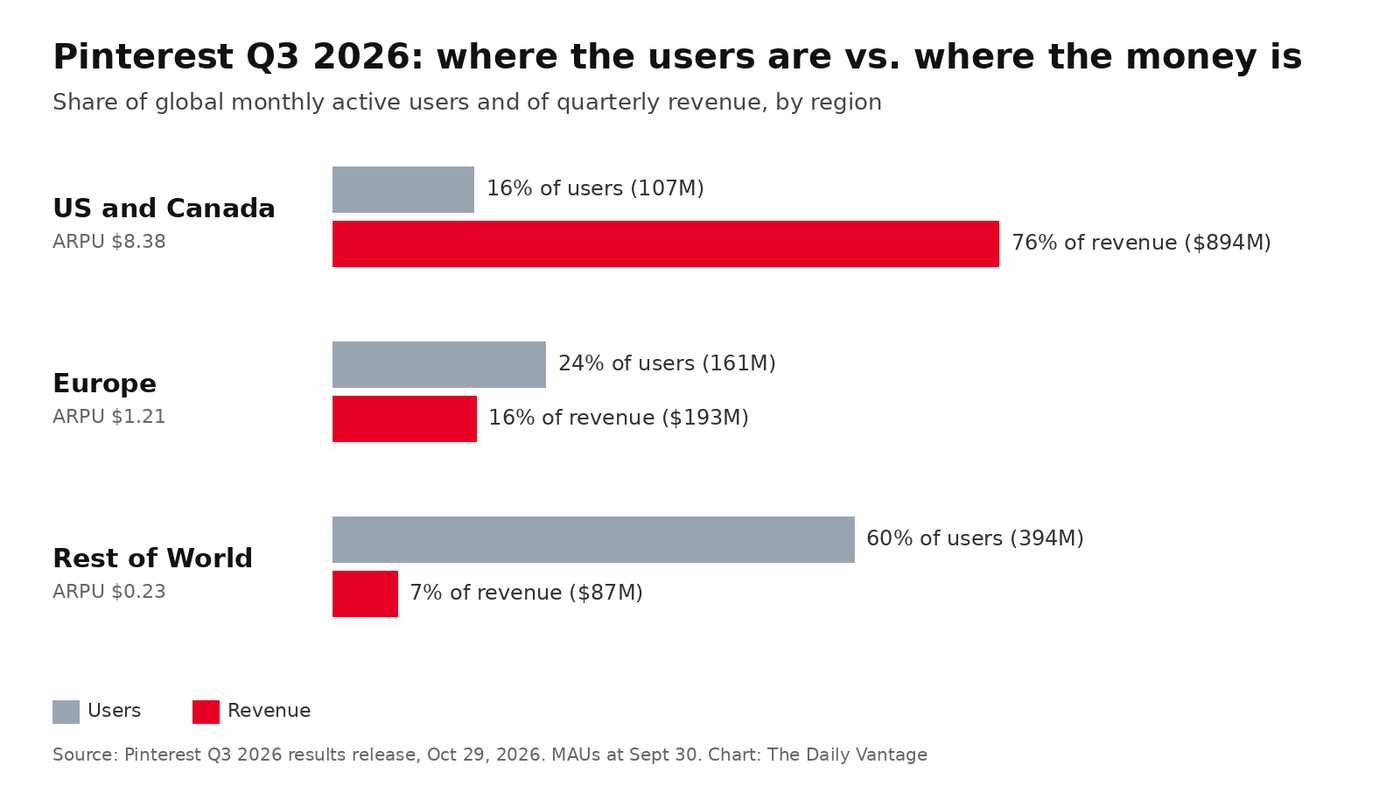
Average revenue per user (ARPU) shows the same split. A North American user brought in $8.38 during the quarter, up 10%. A European user brought in $1.21, which was down 7%. A Rest of World user brought in 23 cents. In other words, one US or Canadian user was worth about as much as 36 users elsewhere.
Where the 61 million new Pinterest users came from
Comparing these Pinterest earnings with the same quarter of 2025 makes the imbalance clearer. We subtracted last year’s numbers from this year’s for each region.
| Region | Users, Q3 2025 → Q3 2026 | Users added | Revenue, Q3 2025 → Q3 2026 | Revenue added |
|---|---|---|---|---|
| US and Canada | 103M → 107M | +4M | $786M → $894M | +$108M |
| Europe | 150M → 161M | +11M | $193M → $193M | $0 |
| Rest of World | 347M → 394M | +47M | $70M → $87M | +$17M |
| Total | 600M → 661M | +61M | $1,049M → $1,174M | +$125M |
The region that added the fewest people produced almost all of the growth. North America gained 4 million users and $108 million in revenue, which is 86% of the company’s added revenue. By contrast, Rest of World added 47 million users, more than three quarters of the total, and $17 million.
That is not a failure in itself. Pinterest is cheap to use and easy to grow in markets where ad prices are low. However, it means the headline user record does very little for the income statement in the short term. As a rough illustration, if those 394 million users earned Pinterest what a European user does, the region would bring in close to $480 million a quarter rather than $87 million. Chief executive Bill Ready told analysts the company is “only about three years into our performance advertising journey,” and that it is now running its North American playbook abroad.
Europe’s stall in the Pinterest earnings report
Europe is the odd one out. Users there grew 7%, yet revenue stayed flat at $193 million. On the Pinterest earnings call, executives blamed a customs change, not a drop in interest.
From July 1, 2026, the EU ended the duty-free treatment of parcels worth up to €150 and introduced a temporary €3 customs duty per item category, the European Commission explains. The duty is aimed at low-value goods shipped straight to shoppers from outside the bloc. Those cross-border sellers had been big Pinterest advertisers in Europe, and many pulled back.
Pinterest said that pullback knocked about 11 points off Europe’s growth and about 3 points off global growth. Ready called the impact “greater than we anticipated” and said, “We are not happy with that result.” The company also does not expect that spending to return for the holiday season. Notably, the same sellers had moved budgets into Europe after US tariff changes last year. Now both doors are narrower.
More ads, at lower prices
Two more figures from the Pinterest earnings call matter for anyone who buys or sells on the platform. Ad impressions rose 17%, but the average price of an ad fell 4%. So Pinterest showed more ads and charged less for each one.
For small brands and creators who promote their own Pins, softer prices can mean cheaper reach, at least for now. Pinterest also recently let brands promote creator Pins without a prior deal, which adds more paid distribution to the same feeds. Ready also said searches, boards created and outbound clicks in North America all grew faster than users, a sign that the existing audience is using the app more.
Profit went the other way. Net income fell 77% to $22 million, while stock-based compensation rose by $56.6 million to $291.7 million, according to the company’s quarterly report.
Reddit and YouTube show a similar pull toward North America
Pinterest earnings were not the only results out on October 29. Reddit’s US daily audience fell 2% to 50.7 million, even as each US user brought in $13.82, as we covered in our look at Reddit’s plan to require logins. Pinterest at least grew its North American base by 4%. The two companies count users differently, daily versus monthly, so the figures are not directly comparable. Still, both now lean on a mature home market for most of their money.
Even YouTube, with a far larger ad business, saw growth cool this quarter, as our breakdown of Alphabet’s third-quarter YouTube numbers showed. Ad dollars are concentrated, and audiences in fast-growing markets remain cheap to reach.
What the Pinterest earnings mean for creators and sellers
For creators, the most useful lesson in the Pinterest earnings is about audience location. Pinterest traffic is valued very differently depending on where it comes from. A creator with mostly North American followers sits in the part of the platform advertisers pay most for. Meanwhile, one with a large audience in South Asia, Latin America or Southeast Asia may see strong engagement but far smaller affiliate and sponsorship value from the same views.
A few practical steps follow from the numbers:
- Check the audience location breakdown in Pinterest Analytics before pricing a sponsored Pin. A North American audience is the one advertisers pay for most.
- If you sell into the EU from outside it, budget for the €3 duty per item category and expect competitors to cut Pinterest ad spend, which could lower your own costs.
- Brands now promote existing creator Pins more often, so decide whether to keep that option on or switch it off in your settings.
- Track outbound clicks, not just impressions. Pinterest says clicks are rising faster than users in North America, and clicks are what affiliate programs pay on.
Gen Z also matters here. Ready said that group now makes up 57% of Pinterest users, and that its ARPU is comparable to that of millennials. Creators who reach younger shoppers are therefore aiming at the audience the company itself is betting on.
The figures to check in the next Pinterest earnings release
Pinterest guided fourth-quarter revenue to between $1.425 billion and $1.475 billion, which is growth of 8% to 12%. It widened the range on purpose and said North America should stay strong while Europe stays under pressure.
Three numbers will show whether the plan is working. First, Europe’s ARPU, which needs to stop falling. Second, the Rest of World revenue line, which grew 24% this quarter from a small base. Third, ad pricing, which will show whether more inventory is diluting value. Snap reports on November 4, and set beside these Pinterest earnings, its numbers will give another read on how much of social media’s money still comes from one continent.