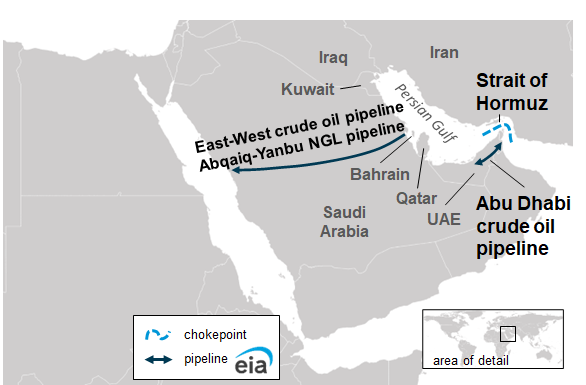
Hormuz shipping traffic slowed at the start of the week as renewed tensions between Iran and the United States pushed oil prices higher and added another layer of uncertainty for markets across Asia and America.
Only seven commodity vessels passed through the Strait of Hormuz on Monday, down from eight the previous day, according to Kpler data reported by Reuters. The count may understate actual traffic because some ships can operate with tracking transponders switched off.
The movement is small in absolute terms, but the direction matters. Hormuz is the principal maritime exit from the Persian Gulf and one of the most consequential points in the global energy system. A prolonged slowdown can raise freight and insurance costs even before a physical supply shortage emerges.
Why Hormuz shipping matters to the world
The U.S. Energy Information Administration estimates that 20.9 million barrels per day of oil moved through the strait during the first half of 2025. That was equivalent to roughly 20% of global petroleum-liquids consumption and one-quarter of worldwide maritime oil trade.
Hormuz also carried more than 20% of global liquefied natural gas trade, primarily from Qatar. That combination makes the route important not only to transport fuels but also to electricity generation, industrial production and household energy costs.
- 20.9 million barrels a day: estimated oil flow through Hormuz in the first half of 2025.
- 89%: share of Hormuz crude and condensate flows sent to Asian markets during that period.
- 11.4 billion cubic feet a day: estimated LNG flow through the strait.
- Limited bypass capacity: existing pipelines can redirect only part of the normal maritime volume.
Saudi Arabia and the United Arab Emirates operate pipelines that bypass the strait, but the EIA estimates their combined available capacity would cover only a fraction of normal Hormuz flows. This is why traders respond quickly to changes in vessel movements, threats against energy infrastructure and higher war-risk premiums.
How Hormuz shipping affects Asia’s supply
Asian economies face the most direct Hormuz shipping exposure because they are the largest destination for oil moving through the strait. China, India, Japan and South Korea together accounted for 74% of the strait’s crude and condensate flows in the first half of 2025, according to the EIA.
That exposure helps explain why Asian markets are sensitive to each escalation. On Tuesday, Brent crude traded near $98 a barrel while regional equities moved unevenly. Indian benchmarks declined, while Japan and South Korea received some support from currency moves and strength in technology shares.
The economic channel is straightforward: higher crude prices increase import bills for energy-dependent economies. Refineries may also face more expensive shipping and insurance. If elevated costs persist, they can move into transport, manufacturing, food distribution and consumer prices.
Japan and South Korea are particularly dependent on imported energy. India imports most of the crude it consumes, while China remains the largest single destination for many Middle Eastern cargoes. The immediate risk is not necessarily that fuel disappears; it is that securing and transporting each cargo becomes more expensive and less predictable.
What Hormuz shipping means for US markets
For U.S. markets, Hormuz shipping matters even though the United States is less directly dependent on Persian Gulf crude than it was several decades ago because domestic production has expanded. The EIA estimated that Persian Gulf oil moving through Hormuz accounted for about 7% of U.S. crude and condensate imports in the first half of 2025.
However, U.S. consumers and companies still pay prices shaped by the global market. A disruption that raises international crude benchmarks can increase gasoline, diesel and aviation-fuel costs even when domestic production is strong.
Higher energy prices can also complicate the Federal Reserve’s inflation outlook. Markets were already preparing for important U.S. consumer-price data and the next policy meeting. A sustained oil shock could slow progress on inflation, pressure household spending and make the interest-rate path harder to predict.
Energy producers may benefit from higher prices, but airlines, logistics companies, manufacturers and other fuel-intensive businesses can face tighter margins. That split often creates sharp sector-level moves even when broad U.S. indexes appear relatively stable.
Why alternative routes cannot replace Hormuz shipping
Oil producers have several ways to reduce exposure to Hormuz, but none can replace the strait at full scale. Saudi Arabia’s East-West pipeline carries crude to the Red Sea, while the UAE operates a line to Fujairah on the Gulf of Oman. Iran also has the smaller Goreh-Jask route.
Those systems provide flexibility, yet their spare capacity is limited. Shipping through the Red Sea can bring a different set of security and insurance challenges around the Bab el-Mandeb strait. Reuters reported that commodity-vessel traffic through Bab el-Mandeb rose to 29 on Monday from 17 the day before, suggesting some activity was shifting across the wider regional network.
The practical result is a global logistics puzzle. Traders must balance cargo availability, tanker locations, insurance coverage, port access and longer sailing distances. Even when oil supply remains adequate, those frictions can keep prices elevated.
Hormuz shipping signals to watch next
The next signal will be whether the Hormuz shipping slowdown lasts for days or develops into a broader disruption. Daily vessel counts alone can be noisy, especially when ships turn off transponders, so the more useful picture comes from several indicators moving together.
- Brent crude: a sustained move around or above $100 would intensify inflation concerns.
- Tanker and insurance rates: rising costs can reveal stress before official trade data.
- Physical cargo delays: postponed loadings or port congestion would indicate a deeper disruption.
- Pipeline use: increased flows through Saudi and UAE bypass routes would show producers adapting.
- Diplomatic signals: any reduction or escalation in U.S.-Iran tensions could quickly change risk pricing.
For now, Hormuz shipping data points to slower movement and higher risk rather than a complete closure. But because Hormuz sits at the intersection of Middle Eastern security, Asian energy demand and global inflation, even a modest traffic decline deserves close attention.
Reporting note: This article combines current vessel and market reporting from Reuters with energy-flow estimates from the U.S. Energy Information Administration. Map data and featured graphic: U.S. EIA.
Follow continuing developments on The Daily Vantage latest news desk and read our recent analysis of China’s capital injection into banks and insurers.