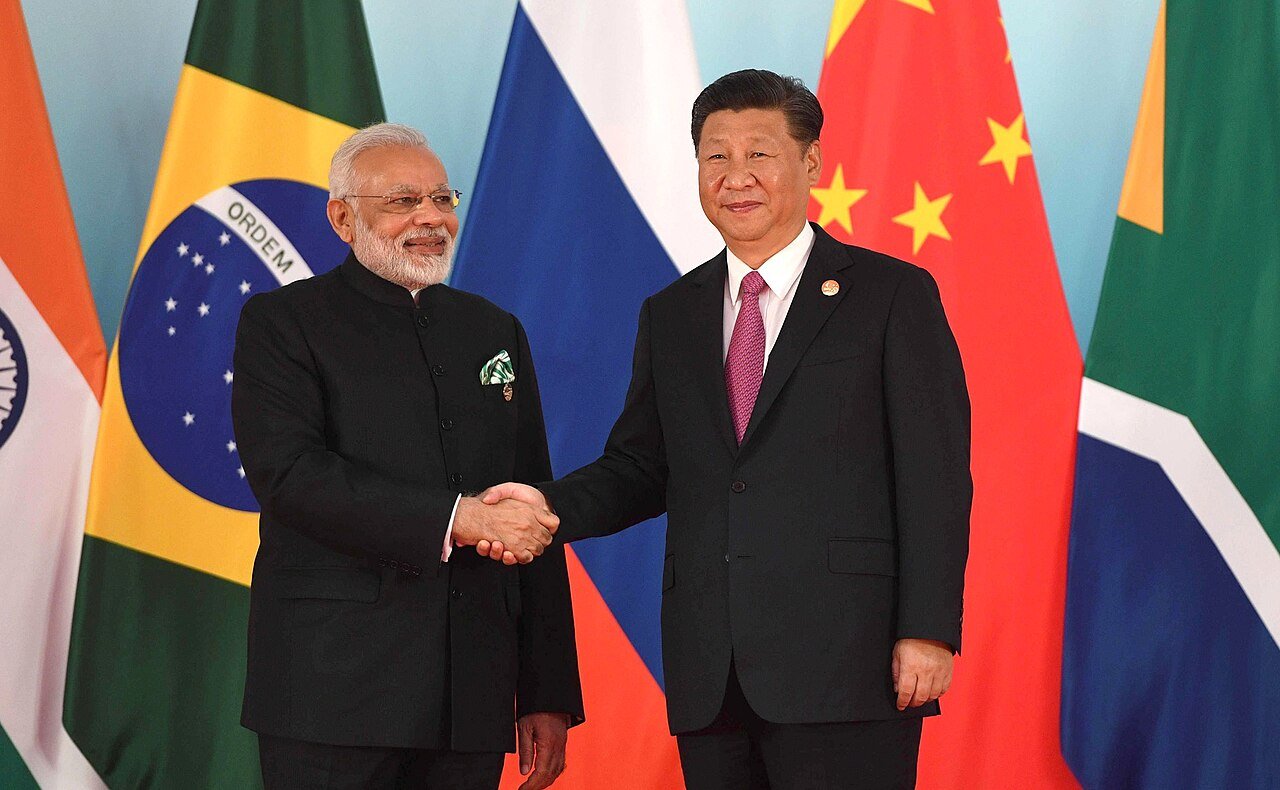
Indian Prime Minister Narendra Modi and Chinese President Xi Jinping held talks in New Delhi on September 12, using the BRICS summit to push for steadier relations while acknowledging the importance of peace along their disputed border.
Reuters and the Associated Press reported that the leaders discussed trade, people-to-people links and wider cooperation, while the long-running boundary dispute and India’s large trade deficit with China remained unresolved.
What the leaders said
China’s foreign ministry said Xi met Modi during the BRICS gathering. Indian and Chinese officials have both placed the encounter within a broader effort to stabilise a relationship strained by the 2020 border clash and subsequent military deployments along the Himalayan frontier.
The meeting should not be read as a settlement of the boundary question. Reuters reported that both countries still maintain heavy deployments along the frontier, even as diplomatic and commercial contacts have gradually resumed.
Trade remains central
China is a major source of Indian imports, including electronics and industrial inputs. Reuters reported bilateral trade reached a record $155.6 billion in 2025, while India’s deficit exceeded $100 billion. That imbalance gives the talks an economic as well as strategic dimension.
Why it matters
Stability between Asia’s two largest countries would matter for regional supply chains, transport links and investor confidence. It could also reduce the risk that a border incident disrupts a relationship that remains commercially important despite political mistrust.
South Asia angle
For Bangladesh and neighbouring economies, any sustained improvement in India–China ties could support a more predictable regional trade environment. That is a possibility, not an announced outcome: the two governments have not announced a new regional trade arrangement from this meeting.
Featured image: Narendra Modi and Xi Jinping before the 2017 BRICS leaders’ meeting. Kremlin.ru, CC BY 4.0, via Wikimedia Commons. This is a file photograph and does not depict the 2026 meeting.