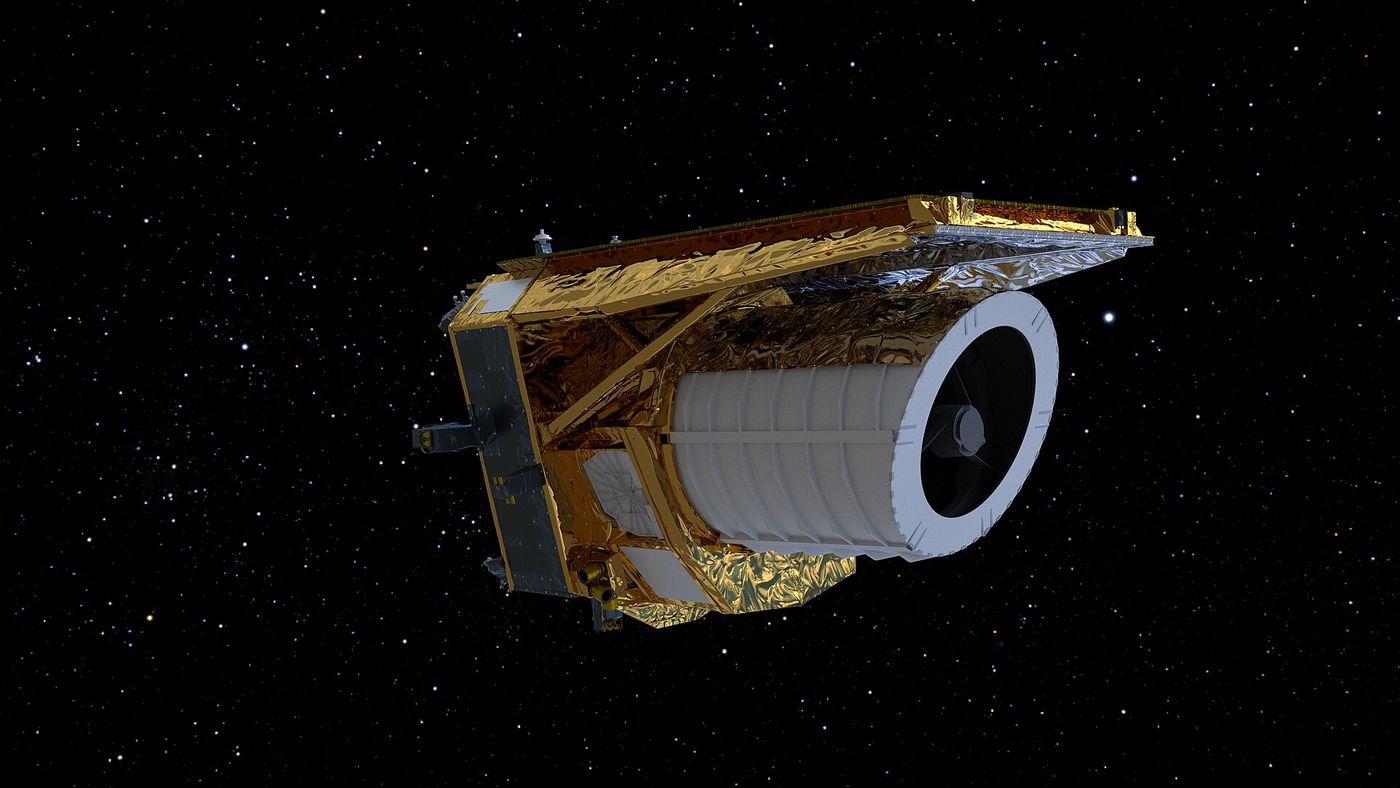
The European Space Agency opened the doors on Thursday, November 12, to the first Euclid data release large enough to start building a real 3D map of the universe. Called DR1-Foundation, it holds more than a billion objects across a patch of sky as big as 9,500 full Moons. Most coverage stopped at the headline numbers. The more useful news is that almost all of it can be browsed, queried and downloaded by anyone, and a good part of it needs no account at all.
Below is what is actually in the package, how big a step it is, and the practical routes into the data, from a point-and-click sky viewer to a public cloud bucket.
What the Euclid data release contains
According to ESA’s announcement, the release covers roughly 13 months of observations. For the main Wide Survey, the NASA-backed Euclid science center at Caltech lists the observing window as February 14, 2024 to May 21, 2025. The headline inventory looks like this:
- more than 900 million galaxies;
- about 15,000 strong gravitational lens candidates;
- more than 60 million quasar candidates, the blazing cores of distant galaxies;
- spectra for more than 160 million sources;
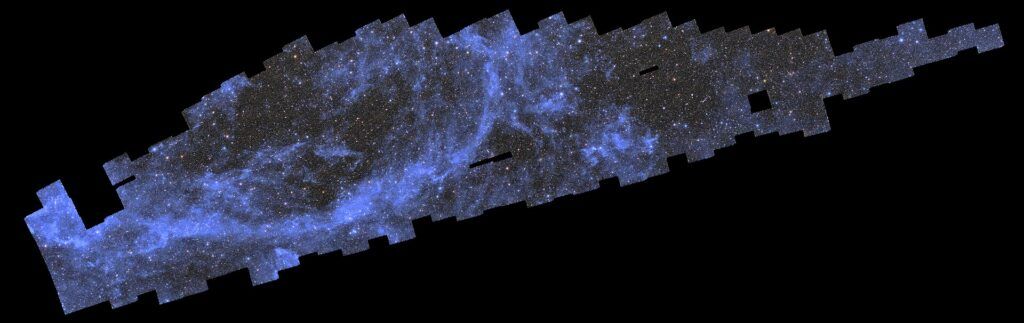
- 1,900 square degrees of Wide Survey sky, amounting to 1.7 million GB of data.
The Caltech DR1 page adds the split. About 500 square degrees sit in the northern sky and about 1,400 in the southern sky. In addition, the package includes the three Euclid Deep Fields (North, South and Fornax), which together cover around 53 square degrees. Raw data from launch up to May 2025 is included as well, alongside calibrated images and catalogs.
A 30-times jump in sky, in plain numbers
Euclid’s earlier public releases held “a few days of observations over around 60 deg² of sky,” said Valeria Pettorino, ESA’s Euclid project scientist. Going from about 60 to 1,900 square degrees is roughly a 30-times increase in area. Even so, it is only about 14% of the sky Euclid plans to cover. The full Wide Survey is designed to reach about 14,000 square degrees.
Some quick arithmetic shows the density. Spread 900 million galaxies over 1,900 square degrees and you get roughly 470,000 galaxies per square degree. Because a full Moon covers about a fifth of a square degree, that works out to around 95,000 cataloged galaxies behind every Moon-sized patch of the surveyed sky. Most of them are far too faint to see with any backyard telescope.
The size also explains why nobody should try to download the whole thing. For example, 1.7 million GB over a steady 100-megabit home connection would take more than four years of nonstop transfer. As a result, the archives are built around searching and cutting out small pieces, not bulk copying.
Fifteen thousand lenses, found by software and volunteers
The standout result is the lens catalog. A strong gravitational lens forms when a foreground galaxy bends the light of a more distant one into arcs or rings. ESA says only one galaxy in several thousand acts as a lens, and many are too small to resolve through Earth’s atmosphere. The new list of roughly 15,000 candidates in the Euclid data release is larger than all previous catalogs combined, according to the agency.
Finding them took machine learning plus thousands of citizen scientists, who sorted images through the Space Warps project on Zooniverse. “Over 10 years ago, we forecast that Euclid would revolutionise the field of strong lens discovery. That day is finally here,” said Natalie Lines of the University of Portsmouth, a Euclid Consortium member. Meanwhile, because every lens was found by the same telescope in the same way, researchers can now study them as a population rather than as rare one-offs. That matters because lenses let astronomers weigh galaxies, including their invisible dark matter.
There is a second, less noticed tool here. The 160 million spectra split each source’s light into a rainbow. Euclid’s team will use them to measure galaxy distances, which turns a flat picture into a map with depth. This step is the one that actually builds the 3D cosmic web.
Browsing the Euclid data release without writing code
The easiest door is ESASky, the agency’s web-based sky atlas. ESA’s DR1 data access page says the catalogs, observations and mosaics sit there as image layers you can zoom into. Anonymous access is allowed for this kind of browsing. You can pan across the survey footprint, zoom into a galaxy group and overlay catalog points without signing up.
For a starting point, ESA’s own showcase images feature the Horologium supercluster and members of the Messier 81 galaxy group. Messier 81 is a bright spiral that many amateur astronomers already know, so seeing it in Euclid’s detail makes a useful comparison with familiar photos.
Registering a free ESA Cosmos account adds longer time limits on database queries and space to save results. It also lets you request access to ESA Datalabs, a browser-based analysis platform that is currently in a moderated public beta. Datalabs comes with familiar astronomy tools such as TOPCAT, DS9 and Aladin preinstalled.
For coders: archive queries, Python and a free cloud copy
Programmers have two main routes. First, the ESA Euclid Science Archive offers web queries and standard astronomy APIs, and the astroquery package for Python wraps those calls. Second, NASA’s Infrared Science Archive at Caltech/IPAC keeps a full copy on Amazon Web Services. Its cloud access page lists the bucket nasa-irsa-euclid-dr1 with the data under the dr1 prefix.
That copy is hosted through the AWS Open Data program, so it needs no credentials and carries no download charges. Most tools expect a login by default, though, so you have to request anonymous access, for instance with the --no-sign-request flag on the AWS command line. IRSA also publishes catalogs and spectra in the HATS Parquet format, which suits large table analysis in Python. Its tutorial notebooks were updated on release day.
What you may do with the images and catalogs
Free to access does not mean free for any use. ESA says all data in the Euclid data release falls under the CC BY-NC 3.0 IGO license. In practice, students, teachers, hobbyists and researchers can use and share the data with credit. However, a company that wants to sell prints or build a paid product on the raw survey would need to check the terms first. Separately, ESA’s press images usually carry their own license, so check each picture rather than assuming one rule fits all.
What arrives after the Euclid data release in 2027
DR1-Foundation is deliberately incomplete. The full Data Release 1, due in mid-2027, adds weak lensing, the subtle distortion that maps dark matter statistically across the sky. It will also add the galaxy clustering measurements needed for cosmology. Those are the results that could test ideas about dark energy, so the biggest scientific claims are still about a year away. Reuters reported that the finished atlas, covering more than a third of the sky, is due in 2031.
Euclid will soon have company. NASA’s Nancy Grace Roman Space Telescope launched on August 30 and, as of NASA’s October 22 update, had entered its final commissioning phase. Caltech’s footprint map shows the DR1 area overlapping the planned Roman high-latitude surveys. Consequently, the same galaxies will eventually be seen by both observatories, which should help each team check the other’s measurements.
Space missions keep handing the public more raw material. We recently looked at how NASA’s twin ESCAPADE probes set up their Mars departure and at the gap left in gamma-ray burst alerts as the Swift observatory winds down. Euclid’s release is different in one practical way: you don’t have to wait for a press image. With a browser and some curiosity, you can look at the same pixels the scientists are mining right now.