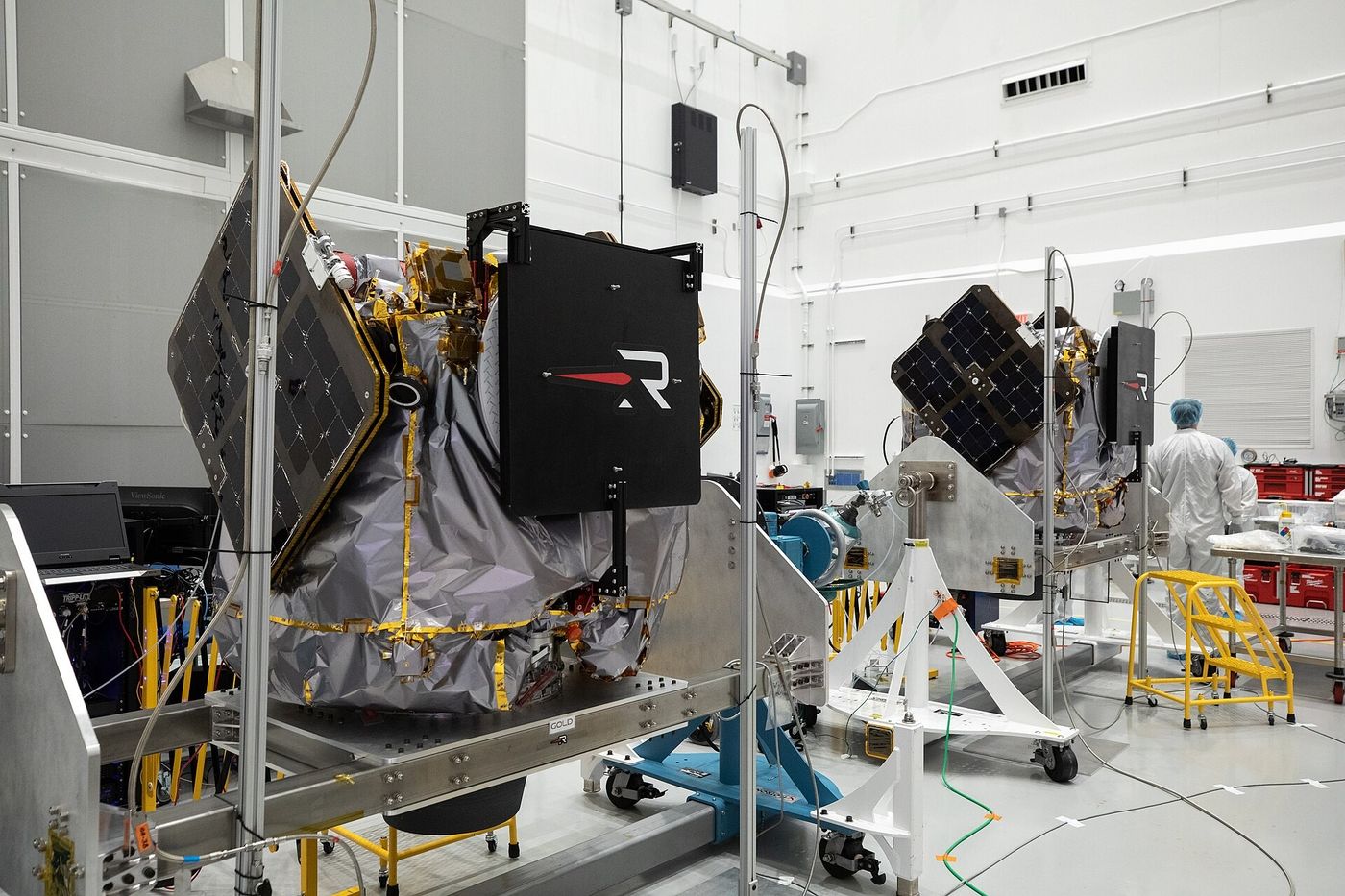
Two refrigerator-sized spacecraft have spent almost a year coasting in a long loop a million miles from home, waiting for Mars to come back around. That wait ends this week. The ESCAPADE Earth flyby is set for Saturday, November 7. That is when the first of NASA’s twin probes swings low over the planet and fires its engine for about nine minutes. Its sibling follows on Monday, November 9. If both burns go to plan, the pair will reach Mars in September 2027.
The mission update NASA posted on November 2 calls this a maneuver no agency spacecraft has flown before. Still, the more interesting story is the year of waiting that came first. That detour could change how small, cheap planetary missions get off the ground.
A year in a kidney-bean loop
ESCAPADE (Escape and Plasma Acceleration and Dynamics Explorers) lifted off on Blue Origin’s second New Glenn rocket on November 13, 2025. At that moment, however, Earth and Mars sat on opposite sides of the Sun. A direct trip was out of the question.
So the spacecraft, nicknamed Blue and Gold, did something new. According to the NASA mission page, they entered a “loiter” orbit around the Sun-Earth Lagrange point 2. That is the same region where the James Webb Space Telescope works. The path traced a kidney-bean shape. It was built to bring both craft back to Earth in November 2026, right as the two planets lined up again.
Rocket Lab built the two spacecraft. It said in an update on its early operations that Gold finished its longest correction burn, 97.7 seconds, on January 6. After that, both spacecraft simply coasted for months.
What the ESCAPADE Earth flyby has to get right
Each ESCAPADE Earth flyby is “powered”. In other words, the spacecraft does not just let gravity bend its path; it also fires its engine at the lowest point of the pass. Engineers call this an Oberth maneuver. A burn delivers the most useful energy when a spacecraft is moving fastest, and a craft moves fastest at its closest point to Earth.
NASA’s numbers show how much depends on those nine minutes. The trans-Mars injection burn should raise each craft’s speed from about 6.3 to about 6.7 miles per second. That is a gain of more than 1,000 miles per hour. Closest approach will be between 600 and 1,100 miles above the surface, which is higher than most satellites fly.
The fuel budget is tight by design. NASA lists each spacecraft at 535 kilograms fueled and 209 kilograms dry, so propellant makes up roughly 61% of launch mass. That fits Rocket Lab’s own figure of 60%. The company also says Blue and Gold carry close to 3 km/s of total velocity change. It adds that they will be the first satellites to travel from Earth orbit all the way into Mars orbit under their own power.
Two missed rides created the detour
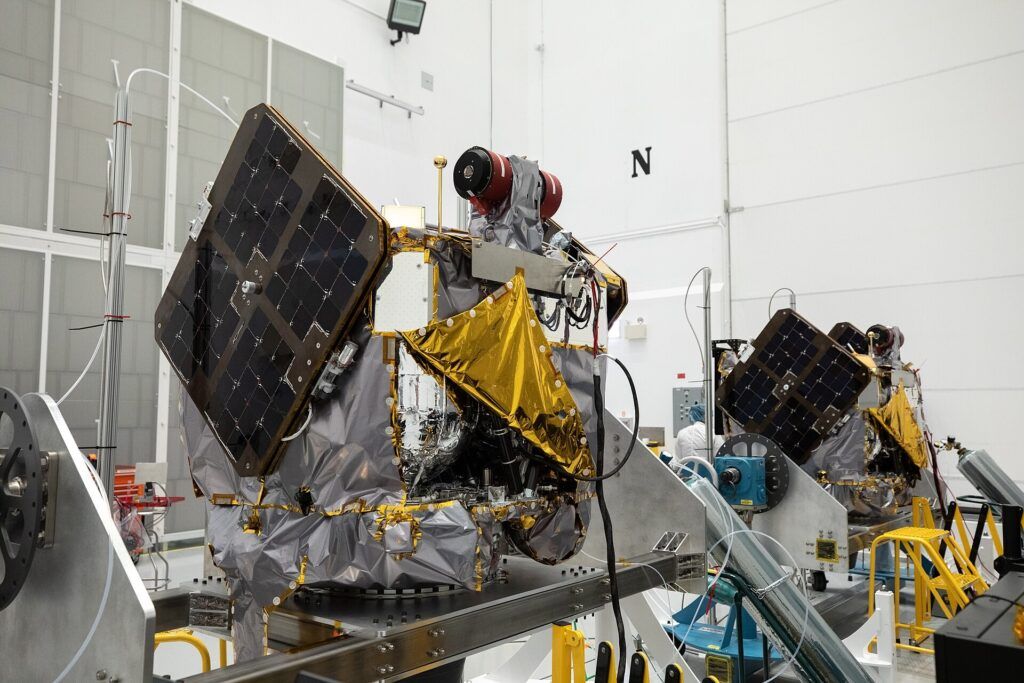
The loiter orbit, and the ESCAPADE Earth flyby that ends it, were not part of the original plan. ESCAPADE was first meant to ride along with NASA’s Psyche asteroid mission in 2022. However, Psyche moved to a more powerful Falcon Heavy, and the new trajectory no longer suited the small Mars probes. The UC Berkeley Space Sciences Laboratory, which leads the mission, says the team then received nine extra months and $1.8 million. The goal was to redesign it “to be as flexible as possible in terms of launch.”
The second setback came in 2024. ESCAPADE was booked on the first New Glenn flight for an October window. Then, on September 6, NASA stood down before fueling the spacecraft. SpaceNews reported that the agency wanted to avoid the cost and difficulty of draining toxic propellant if the untested rocket slipped. New Glenn first flew in January 2025, months after that window had closed.
Under the old rules, each slip cost the mission about two years, because Earth and Mars line up only every 26 months. The loiter plan broke that link. As a result, the probes could launch on the rocket’s schedule and then wait in space instead of in a clean room.
Bonus science from Earth’s magnetic tail
The waiting year was not idle. On their loop, Blue and Gold passed through a distant stretch of Earth’s magnetotail. This is the part of our magnetic field that the solar wind drags out behind the planet. NASA says no spacecraft had directly explored that region before. Mission scientists report “interesting activity and structure” there and plan to publish soon.
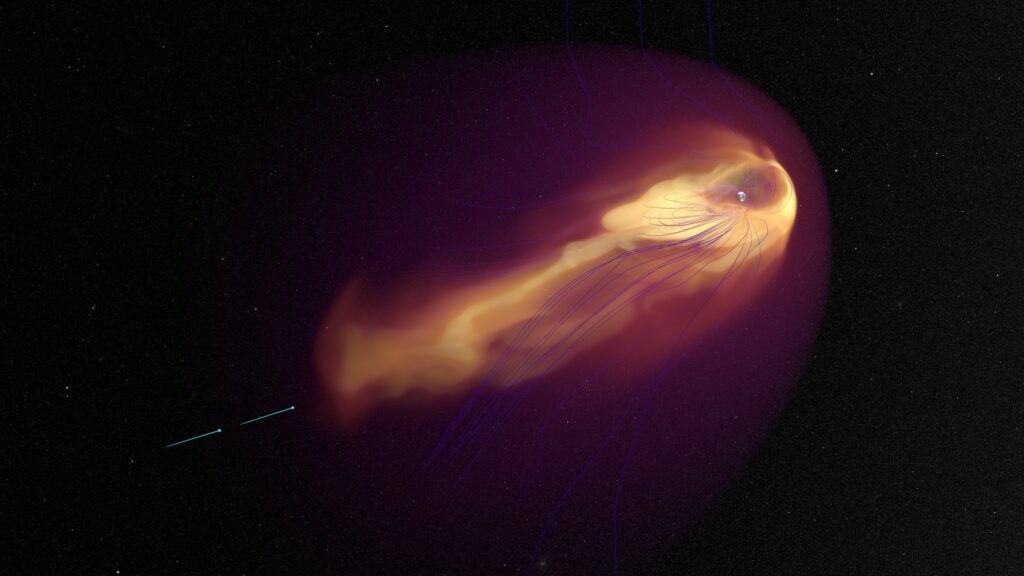
That pass doubled as rehearsal. At Mars, the pair’s main task is to measure how the solar wind strips gas from the planet’s thin upper atmosphere. Studying a similar process near Earth first gives the team a known reference point. The same patience also produced a July 3 family portrait of Earth and the Moon. Principal investigator Rob Lillis of UC Berkeley told NASA that imaging such well-known targets gave the mission’s Northern Arizona University cameras “an important calibration check” before Mars.
Timing the ESCAPADE Earth flyby from Dhaka and beyond
Both burns happen over southern Australia. For readers in Bangladesh, the first engine firing begins at 3:51 PM Dhaka time on Saturday, November 7. The second starts at 4:51 PM on Monday, November 9. That is daylight in Dhaka, and the craft will sit well below Bangladesh’s horizon. Local readers will see nothing, but the afternoon timing makes the event easy to follow online.
Sky watchers elsewhere have a better chance, though they will need a telescope. NASA says each craft should be faintly visible from the western United States in the hours before its burn. The best windows run from midnight to 1 a.m. PST on November 7 and from 1 to 2 a.m. PST on November 9. Observers in southern Australia may catch the burns themselves at 8:51 p.m. and 9:51 p.m. AEDT. For exact pointing, NASA recommends the JPL Horizons system.
What a clean ESCAPADE Earth flyby would prove
NASA’s launch-day release spelled out the bigger idea. With this type of path, “future missions could launch nearly anytime and wait in space, queueing up for their interplanetary departure.” For a low-cost mission, that flexibility matters a great deal. Boston’s Museum of Science puts ESCAPADE’s total cost at just under $80 million, which is small change by Mars standards.
Yet the model has limits worth stating plainly. A loitering craft needs enough fuel to wait, correct its path and still make the departure burn, which is why propellant dominates ESCAPADE’s mass. It also spends an extra year exposed to radiation and wear before the main mission even starts. Heavier landers and rovers may find that trade much harder to make. For now, success would show that the queue works for small orbiters. That alone could widen access for university-led science.
NASA has a busy exploration calendar either way. Our look at how Artemis III’s 2027 docking test shapes the 2028 Moon landing covers the agency’s crewed plans. Meanwhile, its push to share planetary data more openly showed up earlier this year in the open AI model NASA and IBM released for lunar science.
The road from here to Martian orbit
Several days after each ESCAPADE Earth flyby, the team will learn how well the spacecraft are aimed. After that, the schedule set out by NASA and UC Berkeley runs as follows:
- November 7 and 9, 2026: powered flybys and nine-minute departure burns.
- Late 2026 to mid-2027: a ten-month cruise with several small correction burns.
- September 7 and 9, 2027: arrival, with burns of about 11 minutes to enter large capture orbits lasting roughly 60 hours.
- Late 2027: orbits tightened before solar conjunction cuts contact with Earth.
- June 2028: science begins, first in a “string of pearls” formation and later in two different orbits.
NASA plans the first campaign for six months and the second for five. If the burns go well this week, the agency will have flown its first coordinated two-spacecraft orbiter mission around another planet. Just as important, it will have shown that a missed launch window no longer has to mean a two-year wait on the ground.