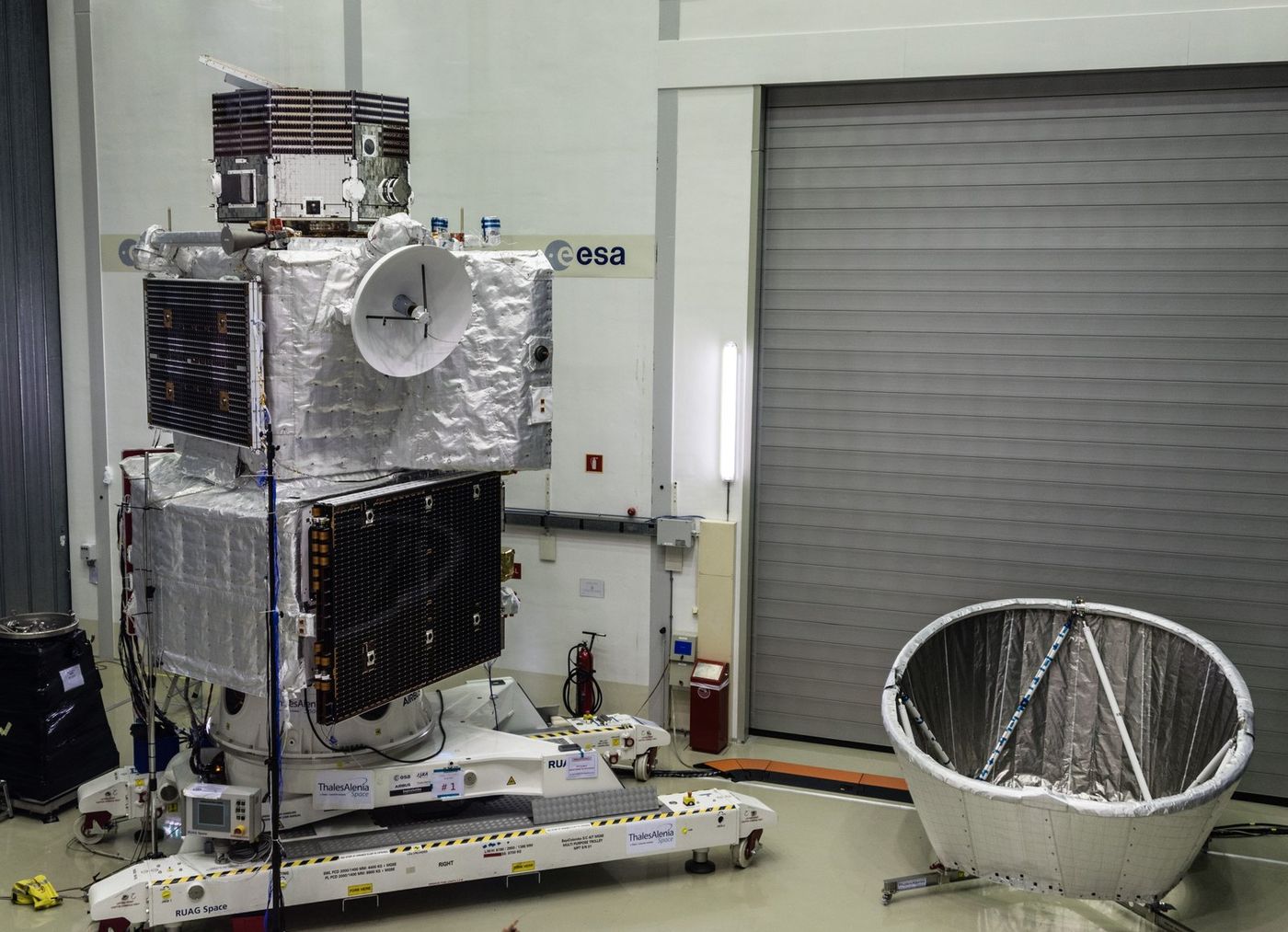
It took eight years, nine planetary flybys and roughly 10.2 billion kilometres of travel, but on Saturday, November 21, Mercury’s gravity finally held on to BepiColombo. The BepiColombo Mercury orbit that the European Space Agency (ESA) and Japan’s space agency JAXA now have to work with, however, is enormous. According to ESA’s arrival media kit, Mercury’s grip leaves the stacked spacecraft roughly 674 by 178,000 kilometres above the surface. Its two science orbiters will eventually need orbits that top out at 11,640 km and 1,500 km.
That gap is the real story of the next four months. It also explains why a short line posted by ESA’s operations team on Sunday deserves attention. The arrival burn, a planned 37-minute firing of four thrusters on ESA’s Mercury Planetary Orbiter (MPO), “was shorter than planned following a software issue,” the team wrote on X. The spacecraft is safe, and engineers at ESA’s control centre in Darmstadt are investigating. ESA promised a fuller update on Monday, November 23. It had not appeared when this article was written on Monday morning, Dhaka time.
So capture is done. Even so, the part of the plan that turns a loose orbit into two working science orbits has only just begun.
What Saturday’s burn settled, and what it left open
The good news is the hardest to reverse. ESA’s flight dynamics team confirmed orbital capture late on Saturday, after a tense wait for the signal to return, as Space.com reported. Mercury now holds the spacecraft. That makes BepiColombo only the second mission ever to orbit the planet, after NASA’s MESSENGER.
What remains open is the exact shape of the BepiColombo Mercury orbit after the shortened burn. ESA has not published new numbers. Because the first burn was meant to start tightening the loop, a shortfall most likely means the orbit is somewhat larger than planned. Making up the difference would then fall to later maneuvers. That is an inference, not an ESA statement, and Monday’s update should confirm or correct it.
The cause matters as much as the size. A one-off command error can be fixed and forgotten. By contrast, a fault in the software that ends burns early would hang over every one of the maneuvers still to come.
The BepiColombo Mercury orbit has to shrink more than 100-fold
Here is the scale of the job, using the altitudes in ESA’s own timeline:
- Capture, November 21: about 674 by 178,000 km above the surface, with MPO and Mio still stacked together.
- Mio release, December 9–10: Mio goes onto its final 590 by 11,640 km polar orbit.
- Sunshield ejection, December 16: MPO drops Mio’s protective cover and starts lowering its own orbit.
- MPO in place, March 10, 2027: a 480 by 1,500 km polar orbit, about 109 days after capture.
- Science begins, April 6, 2027: 136 days after Mercury first held the spacecraft.
Divide 178,000 by 1,500 and the farthest point of the orbit must come down by a factor of about 119. Even Mio, the Japanese orbiter that keeps a deliberately stretched path to sample Mercury’s magnetic environment, needs its high point cut by a factor of about 15.
For this reason, ESA spreads the work across many firings rather than one heroic burn. The independent tracking site Orbinauts, citing ESA’s planning, counts 16 burns between November 21 and March 2027.
A calendar with an eclipse in it
The dates are tight at the front end. ESA has scheduled Mio’s release for December 9 or 10, only 18 to 19 days after capture. Then, on December 16, MPO should drop the sunshield that has protected Mio since launch.
In ESA’s September 3 broadcast, spacecraft operations manager Ignacio Clerigo described a first block of five burns, roughly one every three days, to shrink the orbit enough for Mio’s release, Orbinauts reported. Those burns have to finish before Mercury’s long eclipse season in early December. Otherwise the stack could spend too long in shadow and drain its batteries.
That deadline is why a software fault on day one matters more than its size might suggest for the BepiColombo Mercury orbit. If the first burn delivered less than planned, the remaining burns in that block carry more of the load, and there is little calendar room to add new ones before the shadows arrive. ESA has said only that its arrival dates “may change for operational reasons.” It has not yet said whether this one will.
Why MESSENGER needed one burn and BepiColombo needs sixteen
The contrast with NASA’s earlier mission is striking. On March 17, 2011, MESSENGER’s main engine fired for about 15 minutes, slowing it by 862 metres per second and putting it straight into its working orbit, according to the Johns Hopkins Applied Physics Laboratory. Primary science began on April 4, about 17 days later.
BepiColombo’s equivalent gap, from capture to the April 6, 2027, science start, is 136 days. Building the final BepiColombo Mercury orbit simply takes longer. Several design choices explain the difference. Two spacecraft must be delivered to two different orbits. Moreover, MPO, at about 1,200 kg plus Mio and its sunshield, does the steering alone now that the transfer module separated on September 3. Mercury is also notoriously hard to stop at. ESA points out that settling into a stable orbit there takes more energy than sending a probe to Pluto.
The mission already lost a year once. In 2024, a power problem left the transfer module’s electric thrusters short of full thrust. As a result, arrival slipped from December 2025 to November 2026, Eos noted. The team re-planned around that fault and still made orbit, which is a fair guide to how much margin mission designers build in.
How a slip in the BepiColombo Mercury orbit would reach Mio
Japan has the most riding on the next three weeks. ESA’s timeline has MPO, not Mio, delivering the Japanese orbiter to its science orbit. In other words, Mio depends on MPO placing the pair on the right path before a dedicated spin-and-eject device sets it loose. Mio then spins at 15 revolutions per minute to spread the Sun’s heat across its body.
If the Mio release slips, the rest of the chain moves with it: sunshield ejection, then MPO’s long descent to its 480 by 1,500 km orbit. Meanwhile, the instruments themselves look healthy. ESA reported this autumn that the BELA laser altimeter fired more than 700,000 pulses during tests. It also found that the MERTIS thermal spectrometer had lost little to no sensitivity since its last ground calibration in 2013.
What two orbiters will finally measure
The payoff justifies the patience. MPO’s job is to map the surface, its composition and gravity field. Its radio science experiment will probe the size of Mercury’s oversized iron core. Mio, on a looser orbit, will watch the planet’s magnetic field and how it interacts with the solar wind. That field is offset from the planet’s centre, and scientists still cannot explain what sustains it.
Flying two craft at once is the point of the BepiColombo Mercury orbit plan. MESSENGER could measure the magnetosphere only from where it happened to be. In contrast, the two BepiColombo orbiters can sample it from two vantage points at the same time. As with the Euclid release of 900 million galaxies, the value lies in coverage: more simultaneous vantage points mean fewer guesses. The nominal mission lasts a year, with an extension planned through 2029.
Three things to read for in ESA’s next update on the BepiColombo Mercury orbit
First, the numbers. If ESA publishes the current low and high points of the orbit, readers can compare them with the 674 by 178,000 km capture figure and see how much work the shortened burn actually did.
Second, the cause. A clear explanation, and a statement that the fix has been tested, would matter more than reassurance alone. The same logic ran through NASA’s twin ESCAPADE probes and their two 9-minute burns toward Mars: every later step inherits the precision of the first.
Third, the dates. If ESA keeps December 9 and 10 for Mio’s release, the shortfall was absorbed. If it moves them, the next question is whether the eclipse season forces a longer pause.
Either way, Mercury has already done the part nobody could redo. It caught the spacecraft. Everything from here is careful, incremental work, and the next three weeks will show how much slack the plan really had.