Andrej Karpathy got fed up with his YouTube homepage on a Friday night, and by Saturday he had a replacement. HackerTube, which he launched on October 31, is a YouTube-style site filled only with videos that Hacker News commenters have recommended to each other since 2007. He called his own feed “an enshittified wall of slop.” The fix took about two hours of prompting Claude, he wrote.
Most coverage stopped at the novelty of a weekend AI build. However, the more useful part sits on the site’s data page. Karpathy published the full catalog as a free download, so we pulled the export and counted. The result is a rare look at which YouTube videos a demanding, mostly technical audience keeps sharing years after upload, and which formats it ignores.
A Saturday project built from 39,834 comments
The method matters, because it shapes every number below. According to the documentation that ships with the export, Claude scanned every Hacker News comment from 2007 to 2026 in the public open-index archive for YouTube links. A comment only counted if it carried at least 100 characters of its own text. A video made the cut only when at least three different people mentioned it, in at least three different months.
That filter left 6,454 videos and 39,834 comments from about 15,000 different commenters. Claude Sonnet then labelled each comment’s stance, from “strong recommendation” to “joke” or “critical.” Karpathy’s notes warn that these labels are good but imperfect, with a few percent of noise. The data is released under the Open Data Commons Attribution licence, which is why we can reuse it here.
Not every link was praise. In fact, only 16,184 of the comments, about 41%, actually recommended the video. Another 19,148 cited it neutrally, 2,711 used it as a punchline and 1,791 criticized it.
Half the HackerTube top ten are solo creators
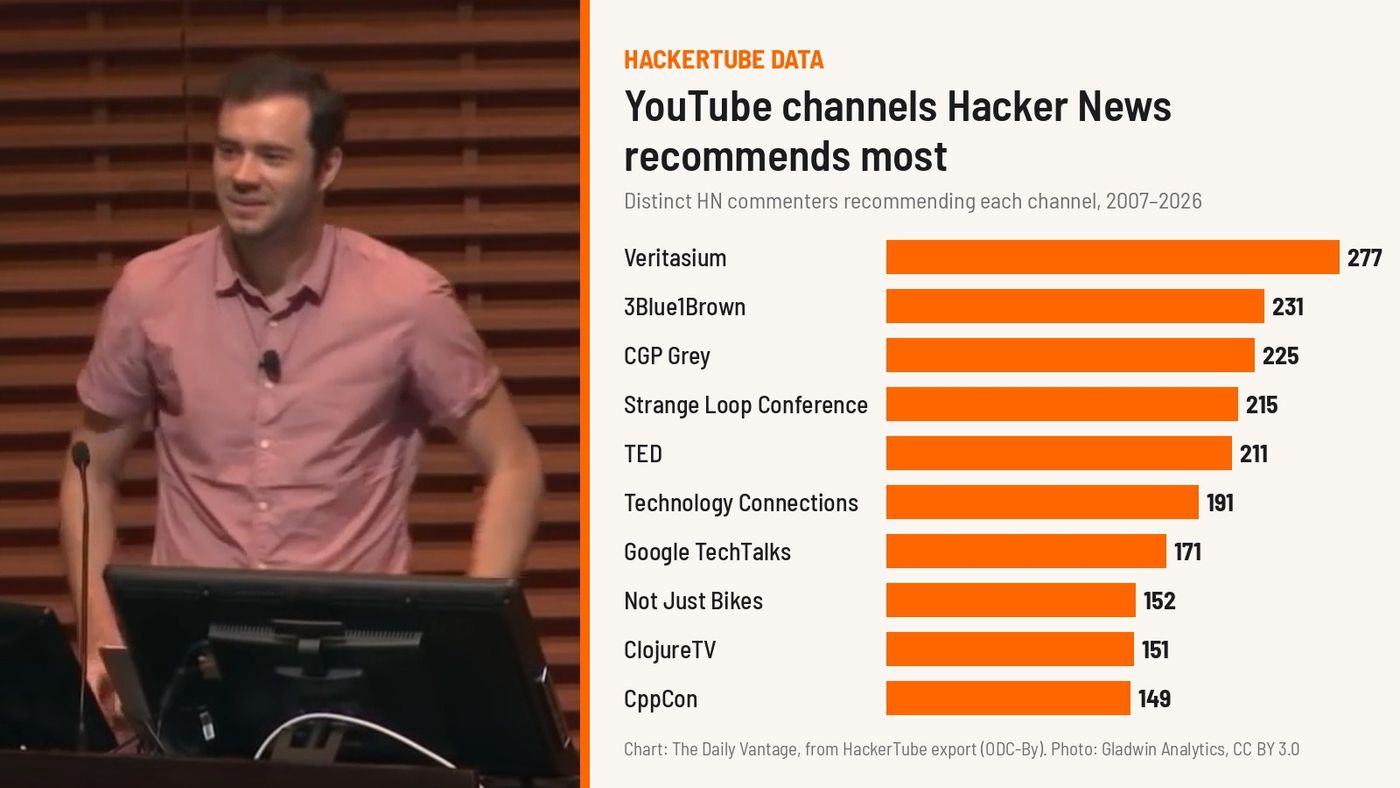
We ranked channels by the number of different people who recommended at least one of their videos. Veritasium leads with 277 recommenders, followed by 3Blue1Brown (231), CGP Grey (225), the Strange Loop Conference (215) and TED (211). Technology Connections, Google TechTalks, Not Just Bikes, ClojureTV and CppCon complete the top ten.
That list splits evenly. Five entries are independent creators who built audiences on YouTube itself. The other five are conferences or institutions that simply upload recorded talks. Notably, none of them is a media company chasing daily trends, and only one, John Oliver’s LastWeekTonight, cracks the top fifteen as a TV brand.
The single highest-scoring video in HackerTube is the first chapter of 3Blue1Brown’s Essence of linear algebra. Seventeen people recommended it across 18 separate months between 2018 and 2026. In second place sits a 2012 RubyConf talk by the late Jim Weirich, uploaded by Confreaks. Karpathy’s own micrograd lecture also ranks among the five highest scores.
One great video is enough to get in
The famous names hide how spread out the list really is. The 6,454 videos come from 3,315 channels, and 2,634 of those channels, almost 80%, appear exactly once. The ten biggest channels account for under 10% of all entries.
In practice, a small channel can sit next to Veritasium if it posted one talk or breakdown that people kept pointing to. Subscriber counts play no part in the inclusion test. Repeated, independent endorsement does. Meanwhile, the 357 channels with three or more entries supply roughly half the catalog, so consistency still pays off over time.
Talks and explainers dominate HackerTube
The format split is the clearest signal for anyone making videos. Recorded talks are the largest group at 1,448 videos, or 22.4%. Explainers follow with 1,091 (16.9%) and demos with 827 (12.8%). Add lectures and full courses, and long-form teaching formats make up more than a quarter of the list.
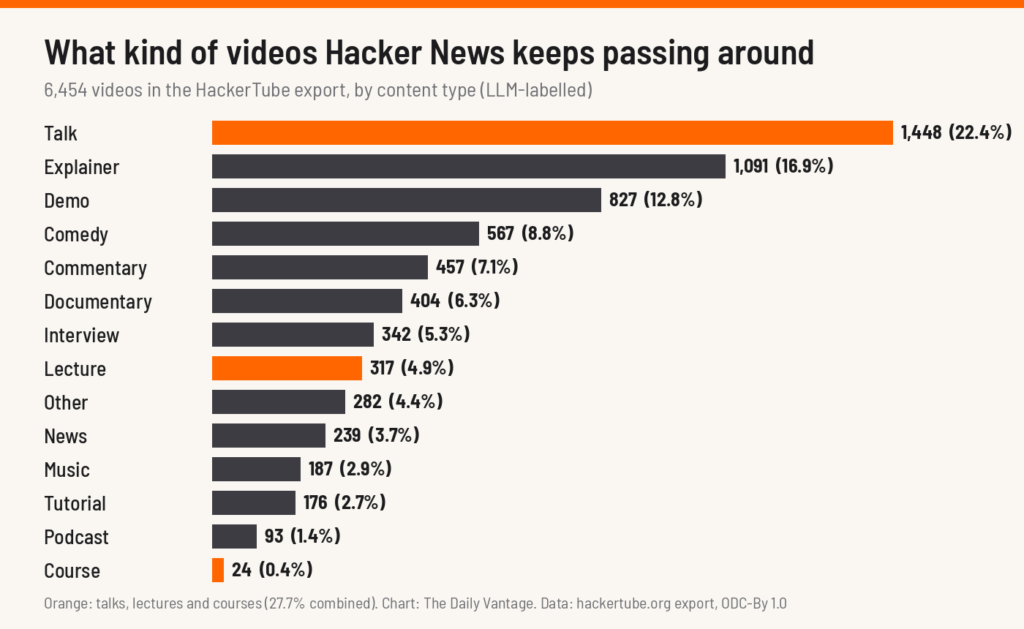
By contrast, formats that dominate creator advice barely register. Tutorials make up 2.7% and podcasts just 1.4%. Comedy looks strong at 8.8%, but the comments tell another story. Of the 3,231 mentions attached to comedy videos, 2,000 were punchlines and only 352 were recommendations. The site itself leans long, with a dedicated “Longs” tab in its menu.
A shelf life measured in years
The labels mark 70% of the videos as “evergreen,” 23% as dated and only 6% as news. The comment dates back that up. Nearly half of all videos (47.6%) were discussed across a span of five years or more, and 12% across a decade or longer.
Older picks have not faded either. Of the 1,704 videos first mentioned in 2015 or earlier, 373 were still being linked in 2025 or 2026. Overall, 1,049 videos picked up at least one mention this year. For a creator, that is a long tail most analytics dashboards never show, because the traffic arrives slowly, from forums and comment threads, years after launch.
There is an important caveat. Because a video needs three people across three months, recent uploads are under-represented. Only 26 entries were first mentioned in 2026, and Hacker News users quickly noticed that the newest videos were months old. As a result, Karpathy added a filter to sort videos by date within a day. So the catalog rewards durability by design, and it cannot judge this year’s videos fairly yet.
Why custom thumbnails never reach HackerTube
One design choice stands out for creators. Instead of the creator’s own custom thumbnail, the site shows a frame grabbed from the middle of each video. YouTube generates that frame automatically. In other words, the packaging creators spend hours A/B testing simply disappears, and a viewer judges the video by its actual content.
That idea struck a nerve. The Hacker News thread about the launch passed 2,600 points and nearly 600 comments about a day after it was posted. Soon after, developers had posted an Apple TV app, an Android TV fork and a page that tracks fresh uploads from channels Hacker News recommends repeatedly. One commenter pointed to YouTube’s own prompt-based custom feeds as an alternative, and another replied that they are only available in the US.
Lessons for channels chasing the algorithm
None of this means YouTube’s recommendations are about to lose their grip. HackerTube is a static list of embedded YouTube videos, and every view still happens on YouTube’s player. Still, the data suggests a few practical points for creators who want a second, slower source of viewers.
- Keep old videos online. The export notes that about 6% of the originally linked videos were already deleted or private. Every removed upload breaks a chain of recommendations that may have run for years. That is worth remembering before using drastic options such as the wipe-the-library route in YouTube’s spam termination test.
- Make the video that people cite. Talks, explainers and demos earned links because they answered a specific question well. A definitive explanation gets reused in arguments for a decade.
- Let the middle of the video sell it. If a mid-video frame says nothing about your topic, curated sites like HackerTube will show viewers a blank wall.
- Watch where links come from. Forum traffic is small next to the homepage, but it is durable. It also lands viewers who chose the video on purpose.
The deeper point is about who controls discovery. Karpathy argued in the thread that people like him are a rounding error in YouTube’s testing, so the main feed will always serve the median viewer. Other commenters pushed back, saying everyone feels like the exception. Either way, HackerTube shows that a small, opinionated community can now build its own front page in an afternoon. If more communities follow, the creators who benefit will be the ones whose back catalogs still hold up.