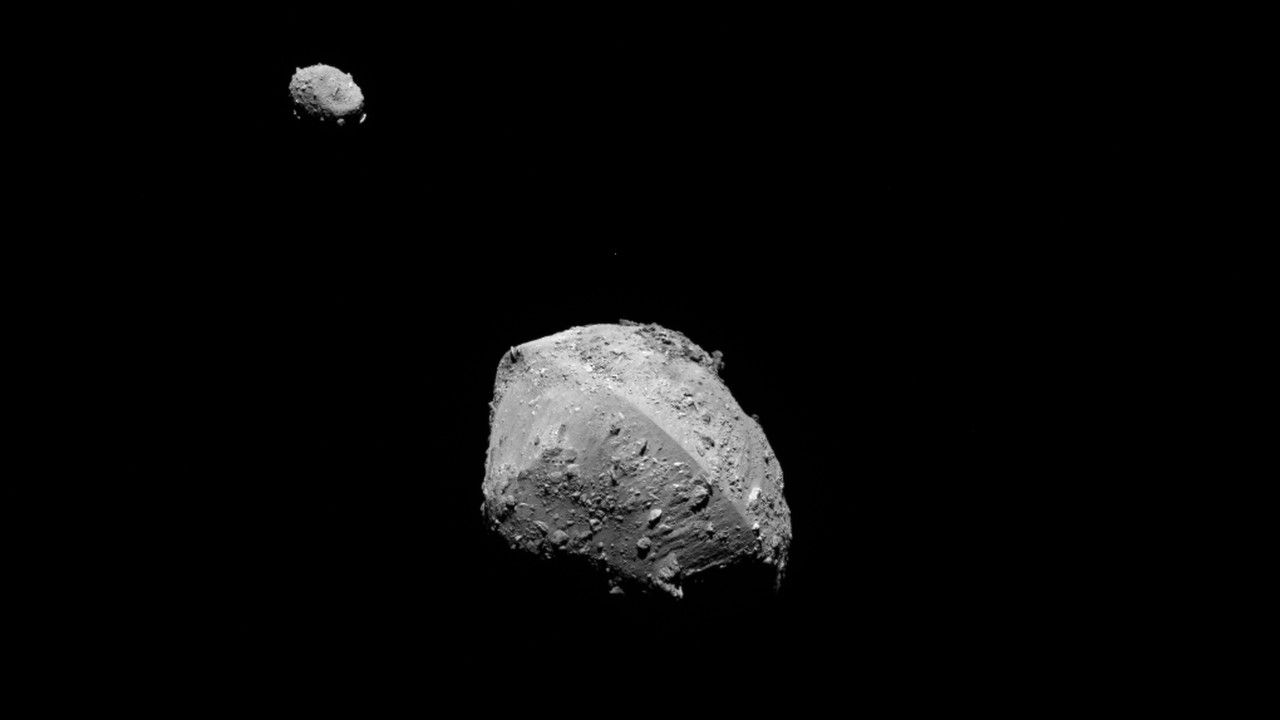
In 2022, NASA flew a 576-kilogram spacecraft into a small asteroid on purpose. Four years later, Europe’s Hera probe has finally seen the damage up close. Images released on November 25 show that the Dimorphos crater is not a neat pit on one side of the moonlet. Instead, the face DART struck has been flattened across the asteroid’s entire width. The 151-metre body is also tumbling as it circles its larger partner, Didymos.
The European Space Agency unveiled the pictures in the dinosaur hall of Berlin’s Museum für Naturkunde, a setting chosen to make a point about extinction-level impacts. The headline finding is vivid, but the more useful story sits underneath it. Each of Hera’s three early surprises lines up against a specific forecast made after the 2022 impact. Some forecasts held, one fell well short, and one key question is still open. That open question decides how much the DART result is actually worth to planetary defence.
Sizing the Dimorphos crater against the Hubble estimate
In July 2023, UCLA astronomer David Jewitt used Hubble images of boulders drifting away from the asteroid to estimate the hole DART left. According to NASA’s summary of that work, the boulders could have come from a circle about 160 feet across. That is roughly the width of a football field. He also said Hera would eventually settle the real size.
It now has, at least in outline. ESA says the crater stretches across the whole struck face of a moonlet that measures 151 metres, or about 495 feet, from side to side. Taken at face value, that makes the scar about three times wider than the Hubble-based figure. Hera principal investigator Patrick Michel said scientists had argued over whether DART would leave a crater, reshape the body or leave it looking the same. “Much to our surprise the answer turns out to be all three at once!” he said. The rest of Dimorphos looks just as it did in 2022.
The key image was taken on 7 November from about 29 kilometres away, at a resolution of 2.7 metres per pixel, according to ESA’s image notes. As a result, the rim, depth and floor of the Dimorphos crater are not yet mapped in detail. The Instituto de Astrofísica de Canarias, which has researchers on the team, quoted Julia de León saying the crater “seems to have some weird structures inside it.”
Why a bigger hole matters for the number 3.61
DART’s success was first measured in minutes. Telescopes and radar on Earth found that the impact cut the moonlet’s orbit around Didymos by 33 minutes, from about 11.92 hours to 11.37 hours. However, the figure planners care about most is beta, the momentum enhancement factor. It compares the push the asteroid actually received with the push the spacecraft alone delivered.
A 2023 study in Nature calculated that DART slowed Dimorphos along its orbital track by 2.70 millimetres per second. That implies a beta of about 3.61 if both asteroids share a density of 2,400 kilograms per cubic metre. In other words, debris blasted off the surface added more than twice as much push as the spacecraft itself. Yet the same paper gave a range of 2.2 to 4.9, because nobody knew the moonlet’s mass.
This is where the new pictures start to matter. A Dimorphos crater spanning the whole face suggests a large volume of material left the surface. That fits a high beta better than a low one. Even so, images alone cannot pin the number down. Hera first has to weigh the moonlet, by tracking how its gravity tugs on the spacecraft and, later, on two CubeSats. The team behind that work described the method in a 2025 paper on Hera’s radio science experiment. Until those measurements arrive, 3.61 remains a best estimate with a wide margin.
A moon that no longer keeps one face toward Didymos
Before the strike, Dimorphos behaved like our own Moon, always showing the same side to its partner. That has changed. “Now it’s very, very chaotic – it’s tumbling,” Hera team member Sabina Raducan told the BBC, comparing the motion to a barrel thrown down a staircase.
This outcome was not a shock to everyone. In 2021, a study led by Harrison Agrusa warned that the impact could push Dimorphos into an excited spin state. That could include chaotic tumbling, depending on how its spin and orbit interacted. Hera has now confirmed that warning in the clearest possible way. The crater itself gives the motion away. In ESA’s animation of a single orbit, the large Dimorphos crater works like a marker, which makes the tumble obvious from frame to frame.
For deflection planners, the tumble matters for two reasons. First, it complicates every follow-up measurement, because the body’s orientation keeps changing. Second, the Agrusa study argued that only a fully coupled spin and orbit model can predict how such a pair evolves. Therefore the tumble has to be folded into any final account of what DART achieved.
From 37 boulders to hundreds
Hubble counted 37 boulders leaving Dimorphos in late 2022, ranging from about 3 to 22 feet across. NASA said their combined mass was roughly 0.1% of the asteroid’s, and they were drifting away at a little more than half a mile per hour. Jewitt described them as a slowly expanding swarm that would still be dispersing when Hera arrived.
Hera’s wide-field Hyperscout H camera has now found hundreds of rocks around the pair. ESA built its picture by stacking 11 long exposures taken on 3 November and removing the two asteroids, so each boulder shows up as a dotted trail. Mission scientist Michael Kueppers called the swarm “another big surprise.”
ESA describes the rocks as just a few metres in size, while the BBC reported sizes from tens of centimetres upward.
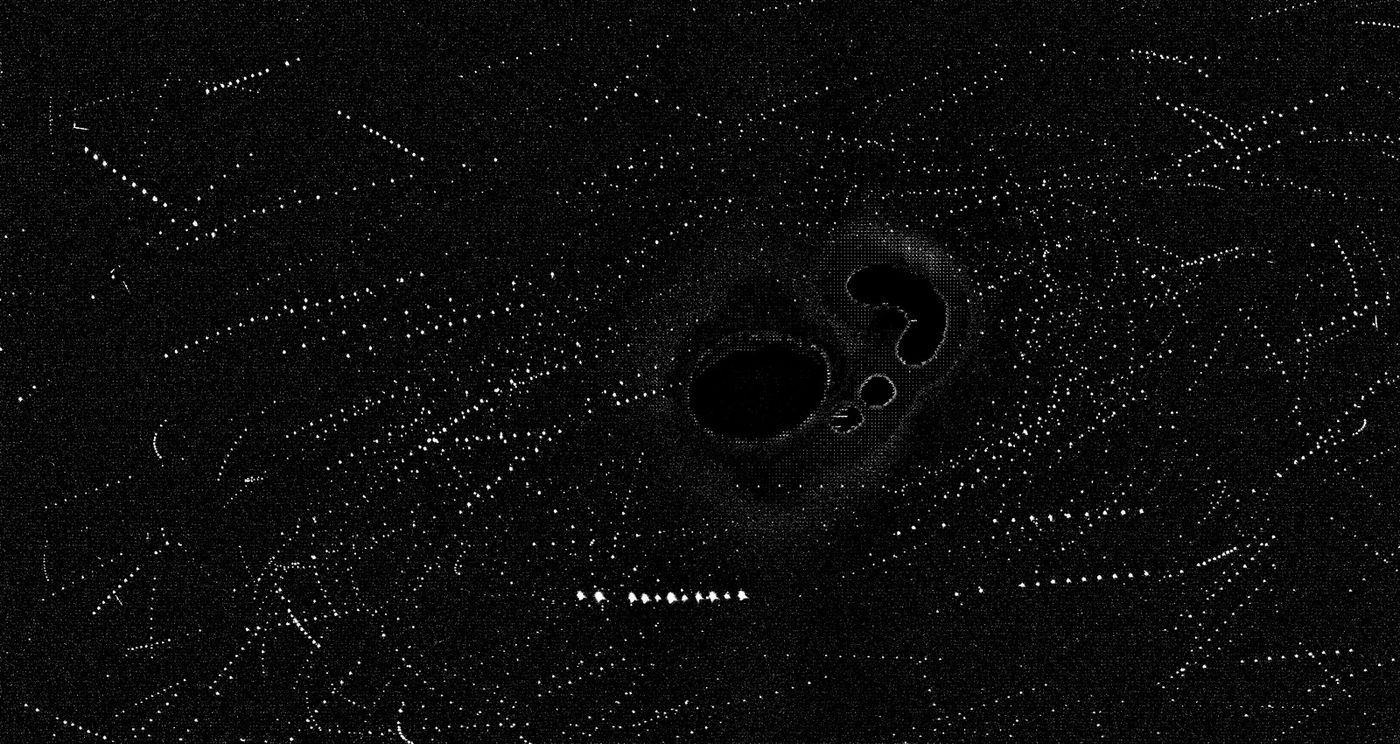
The count has a practical side too. Hera currently holds 25 to 30 kilometres from the asteroids, moving at an average of just 12 centimetres per second. As it moves closer, that debris becomes a navigation hazard. Meanwhile, team member Naomi Murdoch told the BBC that surface gravity on Didymos is about 40,000 times weaker than on Earth. Boulders the size of cars and buses rest on it.
Mapping the Dimorphos crater up close this winter
Hera has a short, busy calendar ahead. ESA says the spacecraft will move to about 13 kilometres from the pair in December, which should sharpen its images. In January 2027, it plans to release two shoebox-sized CubeSats, Juventas and Milani, which will venture closer still. The full sequence looks like this:
- 26 September 2022: DART strikes Dimorphos at 23:14 UTC, travelling at about 22,000 km/h.
- December 2022: Hubble images the boulder swarm leaving the moonlet.
- March 2023: the Nature momentum study puts beta at about 3.61, within a 2.2 to 4.9 range.
- 7 October 2024: Hera launches on a SpaceX Falcon 9 from Cape Canaveral.
- 12 March 2025: Hera swings past Mars and photographs its moon Deimos.
- November 2026: early characterisation from 25 to 30 km; first images released on 25 November.
- December 2026: planned approach to about 13 km.
- January 2027: planned release of the Juventas and Milani CubeSats.
- 13 April 2029: Apophis flies past Earth, the target of ESA’s Ramses mission.
The order matters. Sharper images will show the depth and floor of the crater, and therefore how much material left. Mass from radio tracking then turns beta from a range into a firm figure. Without both, the Dimorphos crater is a striking picture rather than a calibrated result.
What the Dimorphos crater tells planetary defence
The biggest lesson may be that a loosely packed rubble-pile asteroid absorbs a hit very differently from a solid rock. A half-ton spacecraft reshaped an entire face of a 151-metre body without breaking it apart. The recoil from that debris then did much of the pushing. That is encouraging for kinetic impactors, since a high beta means a given spacecraft moves a target further. It also carries a caution, because the extra push depends on the target’s makeup, which may not be known in advance.
ESA is already preparing the next step. Its Ramses mission, developed with Japan’s JAXA, is meant to study asteroid Apophis when it passes about 32,000 kilometres above Earth on 13 April 2029. ESA stresses that the flyby is entirely safe, but it offers a natural test of how a planet’s gravity reshapes an asteroid. Hera’s results also arrive in a crowded season for European space science, from BepiColombo’s shortened first burn at Mercury to Euclid’s 900-million-galaxy data release.
For now, the takeaway is modest but real. DART proved that a spacecraft can nudge an asteroid. Hera is now showing what that nudge did to the target. Over the next two months, it should start to show how much the nudge was worth.