Artemis III is planned as a 2027 test in Earth orbit, while Artemis IV remains NASA’s target for returning astronauts to the Moon in 2028. NASA’s October 23 update detailed how Orion will work with test versions of Blue Origin’s Blue Moon and SpaceX’s Starship before a crewed lunar landing.
The distinction matters when reading launch headlines: a successful Artemis III flight would demonstrate important operations, but it would not itself put astronauts on the Moon. NASA has also left the choice of lander for the first surface mission open, making readiness a decision still to come.
What NASA announced on October 23
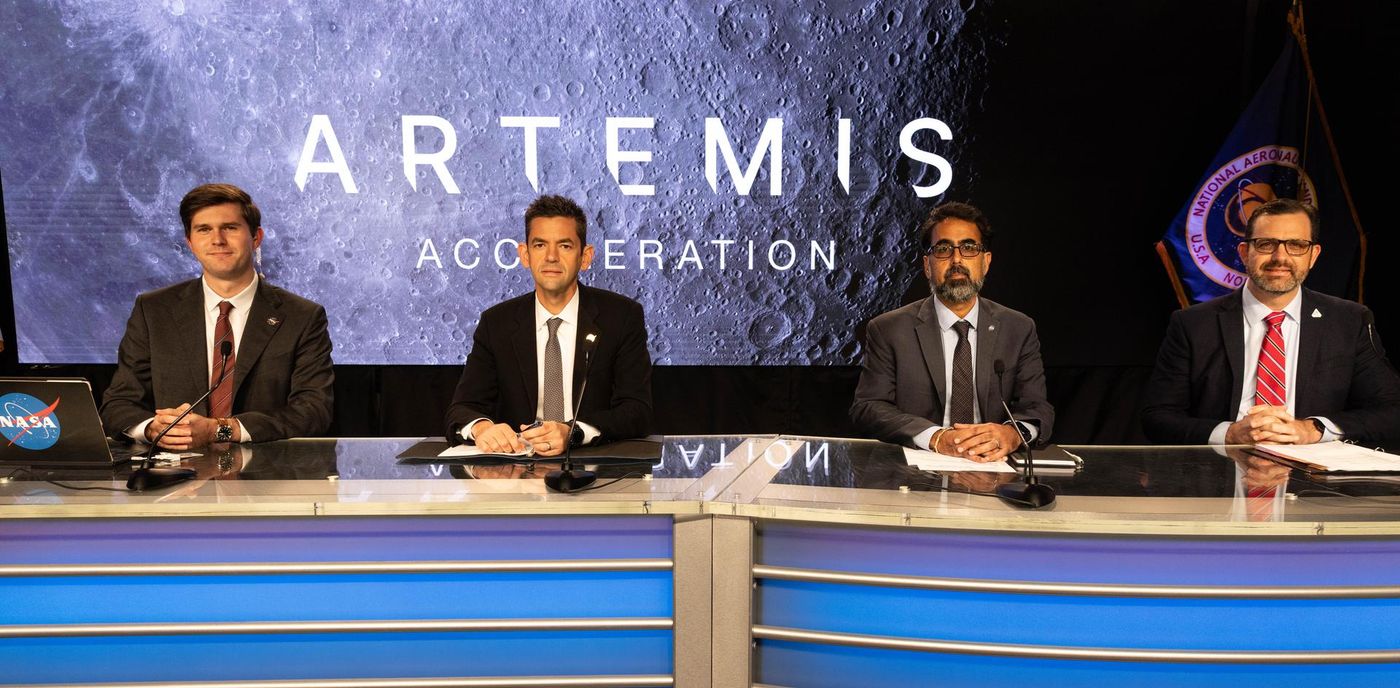
NASA Administrator Jared Isaacman and other agency leaders discussed the program at Kennedy Space Center in Florida. The agency’s official briefing summary describes Artemis III as a four-person mission to low Earth orbit next year, intended to test systems for subsequent lunar landings.
This was an update to an existing strategy, not the first announcement that Artemis III would fly in Earth orbit. NASA’s June 9 crew announcement already described that role. It named NASA astronauts Randy Bresnik, Frank Rubio and Andre Douglas, alongside ESA astronaut Luca Parmitano.
Associated Press coverage of Friday’s briefing reported that NASA continues to aim for next summer’s Earth-orbit flight and a 2028 landing. Those are plans, not completed milestones or guarantees that the remaining hardware will be ready.
Artemis III versus Artemis IV
| Question | Artemis III | Artemis IV |
|---|---|---|
| Planned timing | 2027 | 2028 |
| Destination | Low Earth orbit | The Moon, including a surface landing |
| Main purpose | Test Orion’s operations with commercial lander test vehicles | Conduct the first crewed lunar landing of the Artemis program |
| Important qualification | A docking demonstration does not prove a complete lunar landing | NASA’s lander selection depends on readiness |
The table separates mission objectives from the dates attached to them. A change to a test schedule and a change to a lunar-landing schedule are different developments; neither should be inferred solely from a headline about “Artemis.”
What the Earth-orbit test will actually do
NASA’s detailed Artemis III plan describes a nominal 14-day mission involving three spacecraft launched on three rockets. Blue Origin’s test lander is due to reach orbit first, followed by Orion and its crew on NASA’s Space Launch System. Starship’s test vehicle launches later in the sequence.
The two docking exercises have different goals. Astronauts are expected to enter Blue Moon’s test vehicle and evaluate habitation and joint operations. They will not enter Starship during its docking demonstration, which focuses on how the vehicles operate together.
This provides a useful way to judge progress: ask what a demonstration tests, which hardware is involved, and what it leaves for later. Entering one test vehicle does not mean astronauts will enter both, and docking successfully does not establish that either system has completed its lunar requirements.
Why the 2028 lander choice is still open
In a separate October 23 lander update, NASA said both providers must perform uncrewed demonstrations before carrying astronauts on near-term lunar missions. The agency will certify the systems and determine which provider goes first based on readiness.
The companies are pursuing different approaches. SpaceX’s revised plan uses orbital propellant aggregation and has Starship meet Orion in Earth orbit before sending the combined vehicles toward the Moon. Blue Origin’s accelerated approach defers propellant transfer and uses three transfer stages. These are proposed operations still requiring development and demonstration.
For readers following the program, the key checkpoints are therefore separate: the Earth-orbit docking mission, each provider’s uncrewed lunar demonstration, certification, and NASA’s selection for the first landing. A target date is only one part of that sequence.
Watch the official briefing
Watch NASA’s October 23 Artemis Acceleration briefing on YouTube if the player does not load. The recording is linked from NASA’s own briefing page.
For a different strand of lunar technology research, read our coverage of the NASA–IBM lunar AI model.
Featured photograph: NASA’s Artemis Acceleration briefing at Kennedy Space Center, October 23, 2026. Photo: NASA/Cory S Huston. Source; U.S. government imagery used editorially under NASA media-use guidelines. Resized and shown in theme crops. No NASA endorsement implied.