Yongbyon nuclear complex explained: North Korea’s best-known nuclear centre is not a single reactor or factory. It is a collection of facilities connected to research, reactor operation, uranium enrichment, fuel fabrication and spent-fuel reprocessing. Understanding those separate functions is essential because activity at one building does not automatically prove that every part of the complex is operating.
The site is commonly spelled Yongbyon in international reporting and Nyongbyon in some technical sources. It lies roughly 100 kilometres north of Pyongyang. The International Atomic Energy Agency’s DPRK safeguards history traces the development of a natural-uranium, graphite-moderated reactor there to the late 1970s.
Yongbyon nuclear complex explained by function
The easiest way to understand Yongbyon is to separate it into four broad functions: producing nuclear material in reactors, separating plutonium from spent fuel, enriching uranium and supporting research or fuel production. These pathways involve different buildings, equipment and observable signatures.
The 5-megawatt experimental reactor
The 5 MW(e) reactor is one of Yongbyon’s most closely watched facilities. It uses natural uranium fuel and graphite as a moderator. When such fuel is irradiated, plutonium forms inside it. That plutonium is not immediately usable: workers must remove the spent fuel and chemically separate the plutonium in another facility.
Remote analysts therefore watch more than whether the reactor appears active. Cooling-water discharge, construction and operating cycles can provide clues, but they cannot establish exact production without access to the plant, records and nuclear material.
The radiochemical laboratory
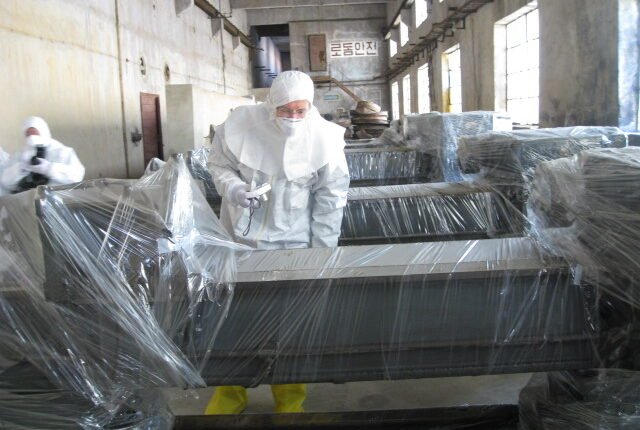
Yongbyon’s radiochemical laboratory is associated with reprocessing spent reactor fuel. Reprocessing separates plutonium from highly radioactive fission products and other material. The Nuclear Threat Initiative’s facility profile describes the centre as containing both reactor and reprocessing infrastructure.
This distinction matters in news coverage. A reactor shutdown, a suspected fuel discharge and activity at the reprocessing building are related observations, but each supports a different conclusion. Analysts should not collapse them into one claim.
Uranium-enrichment facilities
Uranium enrichment offers a separate route to fissile material. Gas centrifuges increase the share of uranium-235 through repeated separation stages. Centrifuges are connected into cascades, and many cascades can operate inside one hall.
In its August 2026 safeguards assessment, the IAEA identified a second enrichment building at Yongbyon by comparing commercial satellite imagery with photographs released by North Korean state media. Our report on the Yongbyon uranium enrichment facility explains the agency’s estimate that the new building could accommodate up to 28 cascades—and why capacity is not the same as verified output.
The experimental light-water reactor
The complex also contains an experimental light-water reactor. Light-water reactors differ from the older graphite-moderated reactor in design and fuel requirements. Monitoring a reactor from outside the country can reveal heat or cooling signatures, yet those signs alone do not provide a complete account of fuel composition, operating history or material production.
Why Yongbyon remains central to nuclear monitoring
Yongbyon is central because several parts of the nuclear fuel cycle are concentrated at one known location. However, it is not necessarily the whole programme. The IAEA also monitors activity at Kangson and other locations using satellite imagery and open-source information.
The agency has not had inspectors in North Korea since 2009. Its conclusions therefore use careful language such as “indications,” “consistent with” and “could accommodate.” Those phrases reflect evidence limits rather than a lack of concern.
What satellite imagery can—and cannot—show
Commercial imagery can reveal new construction, exterior completion, power connections, cooling systems, vehicle movement and changes around known buildings. Official photographs can add details about equipment if analysts can geolocate the interior shown.
Imagery cannot directly measure uranium-enrichment levels, confirm the operating efficiency of centrifuges or establish how much nuclear material is inside a building. Inspectors would normally combine surveillance, seals, records, environmental sampling and material accountancy to reach stronger conclusions.
Yongbyon nuclear complex explained: the bottom line
Yongbyon matters because it links reactors, enrichment and reprocessing infrastructure within North Korea’s best-documented nuclear centre. Each facility supports a different stage of the fuel cycle, and each requires a different kind of evidence. Readers should treat precise production estimates cautiously when inspectors do not have access.
Sources: IAEA safeguards report, August 28, 2026; IAEA DPRK safeguards fact sheet; Nuclear Threat Initiative facility profile. Image used for illustration only.