The Yongbyon uranium enrichment facility has expanded with a new second building that could accommodate up to 28 centrifuge cascades, the International Atomic Energy Agency said in a report dated August 28 and publicised on Wednesday, September 9, 2026.
The finding points to continued growth in North Korea’s capacity to produce enriched uranium, although the IAEA stressed that it cannot confirm the facility’s exact configuration or operating status because its inspectors have not had access to the country since 2009. Reuters reported the findings on September 9, based on the agency’s newly released assessment.
Yongbyon uranium enrichment facility: what the IAEA found
According to the IAEA’s safeguards report on North Korea, construction of the two-storey building began in December 2024. Its exterior was complete by May 2025, and electrical connections, backup generators and six cooling units were installed later that year.
The agency matched commercial satellite imagery of the building under construction with photographs released by North Korean state media after leader Kim Jong Un visited what Pyongyang called a newly inaugurated nuclear-material production factory on June 3, 2026. That comparison led the IAEA to identify the site as Yongbyon Uranium Enrichment Facility 2.
State-media photographs indicated that gas-centrifuge cascades had been installed on both floors. The building could hold as many as 28 cascades of the type shown, the report said. At least one cascade appeared incomplete, and one appeared to use a different configuration from equipment previously observed at Yongbyon and Kangson.
A cascade links centrifuges together so uranium can be enriched in stages. However, the number of cascades a building can hold does not by itself establish how many are operational, how efficiently they work or what enrichment level they produce. The IAEA did not provide a verified production estimate for the new facility.
How the Yongbyon uranium enrichment facility fits a wider expansion
The report also described activity at the Kangson uranium-enrichment site near Pyongyang. The IAEA said there were indications that operations began in January 2026 inside an annex constructed in 2024. It also observed signs that Yongbyon’s original enrichment facility continued to operate during the reporting period.
Taken together, the developments suggest expansion at multiple points in North Korea’s nuclear fuel cycle. The IAEA said the continued operation and reported enlargement of facilities capable of producing weapons-grade material were a cause for serious concern.
The agency separately observed continued activity at Yongbyon’s 5-megawatt experimental reactor and periods of operation at its light-water reactor. Those findings concern different parts of the nuclear complex and should not be treated as proof that every site was operating continuously or at full capacity.
How the nuclear watchdog reaches its conclusions
The IAEA’s assessment comes with an important limitation: it is based on satellite imagery and open-source information rather than inspections inside North Korea. The agency says it has been unable to conduct safeguards activities in the country since April 2009.
That means analysts can identify construction, cooling activity, equipment visible in official photographs and other external signs, but they cannot directly verify the nature and purpose of all work inside the buildings. The report repeatedly distinguishes observed indications from confirmed on-site measurements.
This distinction matters when interpreting claims about nuclear material. Enriched uranium can be produced at different concentrations for civilian or military purposes. External imagery alone cannot reliably establish the enrichment level of material being produced in a specific cascade.
Why the Yongbyon uranium enrichment facility matters
Yongbyon is North Korea’s principal known nuclear complex and contains facilities connected to uranium enrichment, reactor operations and spent-fuel reprocessing. Expanding its enrichment infrastructure could give Pyongyang more capacity to produce material for nuclear weapons, but the scale and pace of any increase remain uncertain without inspections.
The IAEA said North Korea’s continuing nuclear activities violate relevant United Nations Security Council resolutions. Those resolutions call on Pyongyang to abandon its nuclear weapons and existing nuclear programmes and return to international safeguards.
North Korea disputes that framework. Its representatives have described the country’s nuclear status as irreversible and rejected the IAEA’s authority over a state that Pyongyang says is outside the Nuclear Non-Proliferation Treaty. That position leaves the agency relying on remote monitoring while diplomacy over denuclearisation remains stalled.
What to watch next
The immediate question is whether additional imagery provides evidence that more centrifuge cascades are complete and operating. Cooling systems, power infrastructure and construction activity can offer clues, but they cannot replace direct verification of nuclear material and equipment.
The IAEA has said it is maintaining readiness to return if political conditions allow. Until inspectors regain access, estimates of North Korea’s enrichment capacity will continue to carry uncertainty, and new claims should be weighed against the specific language and limitations in the agency’s reports.
Related Yongbyon and enrichment explainers
- Yongbyon nuclear complex explained: how its reactors, enrichment plants and reprocessing facilities fit together.
- Kangson enrichment site: what remote monitoring can and cannot establish.
- Uranium centrifuge cascades explained: why physical capacity is not the same as verified output.
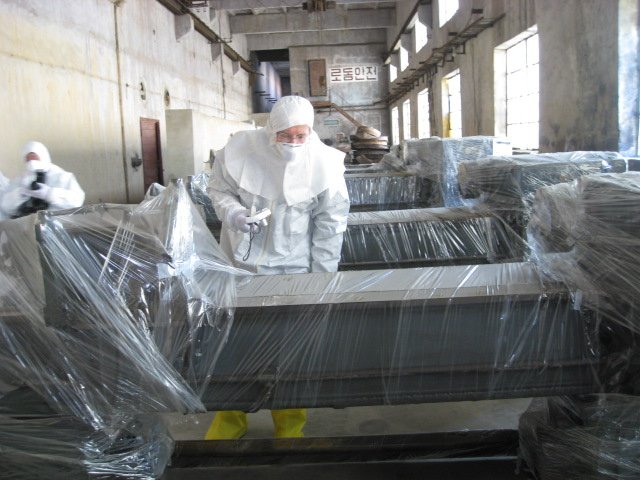
Image credit: Yongbyon Nuclear Scientific Research Center fuel-fabrication facility on February 13, 2008. File photograph by W. Keith Luse, U.S. Senate, via Wikimedia Commons. The work is in the U.S. public domain and marked with Public Domain Mark 1.0. The photograph shows the Yongbyon complex but not the newly identified building.
Source note: This report independently synthesises the IAEA’s August 28 safeguards assessment and Reuters reporting published September 9, 2026. It preserves the agency’s stated uncertainty and does not treat remote observations as on-site verification.
Read more international news and analysis from The Daily Vantage.